There are no items in your cart
Add More
Add More
| Item Details | Price | ||
|---|---|---|---|

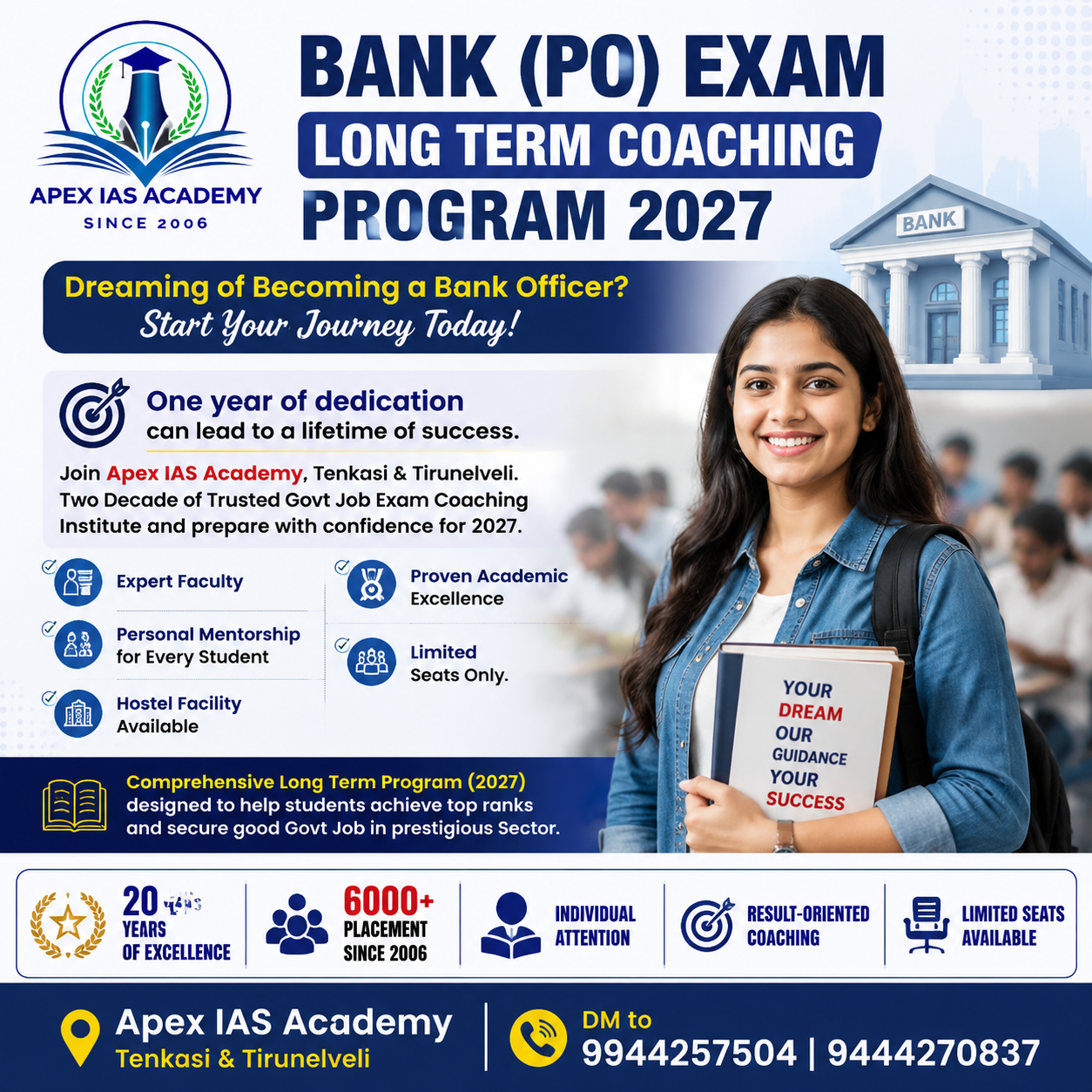
Prepare for India's leading banking examinations with structured coaching, expert guidance, regular practice and focused mock tests.
Join Our Coaching →Prepare for leading banking examinations and build a career across public sector banks, regional rural banks and financial institutions.
Probationary Officer recruitment through IBPS for 11 participating public sector banks.
→Clerical and customer-service opportunities in 11 participating public sector banks.
→Probationary Officer recruitment conducted by the State Bank of India.
→Junior Associate recruitment providing customer-service and clerical opportunities across SBI branches.
→Officer Scale I opportunities in Regional Rural Banks serving rural and semi-urban communities.
→Office Assistant opportunities in Regional Rural Banks with clerical and customer-support responsibilities.
→From the preliminary stage to final selection, understand the key steps candidates may go through in major banking recruitment examinations.
Build your score and qualify for the next stage through the preliminary examination.
Test advanced aptitude, reasoning, English, awareness and other relevant skills.
Applicable to selected officer-level examinations and recruitment processes.
Candidates who successfully complete the applicable stages proceed toward final selection and appointment.
Check the age limit, educational qualification and other eligibility requirements for major banking examinations.
Entry-level officer opportunities across public sector and regional rural banks.
| S.No | Exam Name | Age Limit | Educational Qualification & Requirements |
|---|---|---|---|
| 1 | SBI PO | 21 – 30 Years | Graduation in any stream. No minimum percentage is required. Final-year students can apply provisionally. |
| 2 | IBPS PO | 20 – 30 Years | Graduation in any stream. No minimum percentage is required. |
| 3 | IBPS RRB PO | 18 – 30 Years | Graduation in any stream. Proficiency in the local language of the chosen state is mandatory. |
Entry-level banking roles focused on customer service, clerical operations and branch support.
| S.No | Exam Name | Age Limit | Educational Qualification & Requirements |
|---|---|---|---|
| 1 | SBI Clerk | 20 – 28 Years | Graduation in any stream. Must know the regional language of the state applied for. Final-year students are eligible. |
| 2 | IBPS Clerk | 20 – 28 Years | Graduation in any stream. Proficiency in the applicable state language is required. |
| 3 | IBPS RRB Clerk | 18 – 28 Years | Graduation in any stream. Local language proficiency is required. |
| 4 | RBI Assistant | 20 – 28 Years | Graduation in any stream. Language Proficiency Test requirements may apply. |
Highly competitive examinations for regulatory and development banking institutions.
| S.No | Exam Name | Age Limit | Educational Qualification & Requirements |
|---|---|---|---|
| 1 | RBI Grade B (General) |
21 – 30 Years | Graduation with a minimum of 60% marks across all semesters, or a Post-Graduation degree with 55%. |
| 2 | NABARD Grade A | 21 – 30 Years | Graduation with 60% marks or a Post-Graduation degree with 55% in relevant disciplines. |
Regulatory and development bank examinations may have post-specific academic and subject requirements.
Specialist roles designed for candidates with professional qualifications in specific domains.
| S.No | Exam Name | Age Limit | Educational Qualification & Requirements |
|---|---|---|---|
| 1 | IBPS SO / SBI SO | 20 – 30 Years | Professional qualification related to the domain. Examples include B.Tech in CS/IT for IT Officers, LLB for Law Officers, MBA for Marketing/HR and relevant qualifications for Agriculture Officers. |
Specialist Officer eligibility varies significantly by post. Candidates should verify the qualification required for the specific specialist position.
Build a strong foundation across the core subjects covered in major banking examinations.
Number series, simplification, arithmetic and data interpretation.
Puzzles, seating arrangements, logical reasoning and analytical ability.
Reading comprehension, grammar, vocabulary and error detection.
Current affairs, banking awareness, financial terms and RBI-related topics.
Computer fundamentals, MS Office, internet concepts and cyber security.
Follow a structured preparation journey designed to build your fundamentals, improve exam performance and develop confidence.
Understand the basic concepts before moving to advanced questions.
Solve questions regularly to improve speed and accuracy.
Follow current affairs, banking awareness and important economic developments.
Practice under exam-like conditions and improve your time management.
Review mistakes and focus on your weaker areas.
Structured preparation, expert mentoring and regular practice can help you approach competitive banking examinations with greater confidence.
Learn concepts through clear explanations and exam-focused strategies.
Study with structured materials covering important examination topics.
Practice with mock tests designed to improve speed, accuracy and time management.
Identify your strengths and weaknesses and work towards targeted improvement.
Yes. Many major banking examinations accept graduates who meet the eligibility requirements specified in the latest notification.
It depends on your qualification, age, career goal and preferred organization. Our counsellors can help you understand the available options.
Banking examinations are competitive, but consistent practice, proper guidance and regular mock tests can help improve preparation.
Negative-marking rules vary by examination. Candidates should check the latest official notification.
Preparation time depends on your current level, target exam and daily study time. Consistent preparation is key.
Get the right guidance, practice and preparation strategy for your target banking examination.
 Launch your Graphy